
Beginner guide to sim racing
What is sim racing?
Learn what sim racing is, how racing simulators work, what setup you need, and how to improve with a steering wheel, pedals, data, racecraft and coaching.
Sim racing is realistic virtual motorsport. Drivers use racing simulator software, a steering wheel and pedals to race digital cars on laser-scanned or recreated circuits. Physics, force feedback, tyre behaviour, car setup and race rules all affect lap time, consistency and control.
How it works
How does sim racing work in practice?
Sim racing is not only about driving a virtual car. It combines realistic physics, race rules, hardware feedback and driver skill. The more serious you become, the more it starts to feel like structured motorsport training. Beginners often first want to understand what sim racing is, how sim racing works and what setup they need to start at home.
Sim racing uses realistic racing physics
In sim racing, the car reacts to braking, throttle, steering, kerbs, tyre grip, track temperature and setup changes. A small mistake in braking or steering can cost time, just like in real motorsport.
This is why sim racing rewards control, consistency and understanding. You do not only learn a track. You learn how the car behaves.
A racing simulator is more than a racing game
A racing simulator tries to recreate real driving behaviour. Arcade racing games usually focus more on speed, visuals and entertainment. Both can be fun, but they are not the same.
In sim racing, braking technique, racing lines, tyre management, racecraft and setup choices make a real difference to your performance.
Simple explanation
Sim racing is skill-based virtual motorsport.
You drive against other real drivers or against the clock, using a racing simulator and physical controls such as a wheel and pedals. The goal is not only to go fast, but to drive cleanly, repeat good laps and make better decisions under pressure.
- Sim racing teaches braking, steering, throttle control and racing lines.
- Force feedback helps you feel grip, kerbs and car balance through the wheel.
- Telemetry and lap data show where time is lost or gained.
- Online races add racecraft, pressure, traffic and strategy.
Getting started
What do you need for sim racing?
You do not need the most expensive racing simulator to start. A good beginner setup should give you reliable control, clear feedback and enough stability to build proper driving habits.
Essential sim racing hardware
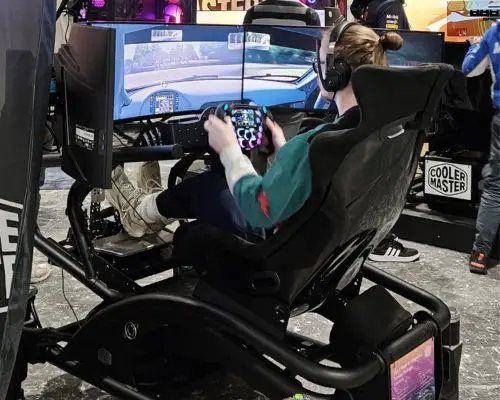
A basic sim racing setup starts with a PC or console, racing simulator software, a steering wheel, pedals and a stable place to mount them. A wheel with force feedback is important because it helps you feel grip, kerbs, slides and car balance.
A solid seating position also matters. If your chair moves, your pedals slide or your screen is placed badly, it becomes harder to drive consistently.
- PC or console
- Racing simulator software
- Steering wheel with force feedback
- Pedals, preferably with a consistent brake feel
- Stable desk, wheel stand or sim racing rig
- Monitor, TV, ultrawide screen or VR headset
How much does a sim racing setup cost?
Sim racing setup costs depend on how serious you want to get. A beginner can start with an entry-level wheel and pedals, while advanced drivers often invest in load cell pedals, direct drive wheels and a rigid cockpit.
Independent setup advice
Abe can help you choose the right sim racing setup
If you are unsure what to buy, Abe Santema can help you choose the right wheel, pedals, rig or upgrade path. His advice is independent. ABEX Works is not sponsored by a hardware brand, so the focus is on what matches your level, simulator, space and goals.
Ask for setup adviceExperience and elite sports context
Serious sim racing takes more than speed
ABEX Works approaches sim racing as performance training. Technique, focus, preparation, racecraft and responsible practice determine how fast and consistent you become.
- Professional sim racing experience
- Contracted as an e-racing talent
- Experience within Papendal’s elite sports environment
- Focus on structure, consistency and racecraft
- Responsible gaming at performance level
Abe Santema is a professional sim racer. As an e-racing talent within Papendal’s elite sports environment, he was contracted by Esports Talent Center Gelderland, where he received coaching and guidance within a professional training programme.
Papendal is the largest TeamNL centre in the Netherlands. It provides an environment where talents and elite athletes train, study and develop with facilities, experts and support in one place. That elite sports context fits the way ABEX Works approaches sim racing: not only as a game, but as training in technique, focus, racecraft and consistent performance.
Sim racing games
Popular sim racing platforms
Different racing simulators focus on different types of racing. Some are better for GT racing, others for endurance racing, online competition or a wide range of cars and tracks.
GT racing
Assetto Corsa Competizione
ACC focuses on GT racing and is popular for competitive online racing, car control, racecraft and setup work.
Best for GT3, GT4, endurance racing and structured performance training.Online competition
iRacing
iRacing is known for organised online racing, licence progression, competitive matchmaking and a wide range of cars and series.
Best for structured online competition and a broad competitive ladder.Mods and variety
Assetto Corsa
The original Assetto Corsa is popular because of its large modding community and wide range of cars, tracks and driving styles.
Best for learning, experimenting and driving many different types of cars.Endurance racing
Le Mans Ultimate
Le Mans Ultimate focuses on modern endurance racing, race strategy and prototype or GT racing in longer race formats.
Best for endurance racing, multiclass awareness and race preparation.Choosing a simulator
Start with one platform first.
Beginners often improve faster when they focus on one simulator, one car and a small number of tracks. Switching too much makes it harder to build consistency. If you want to learn the basic language of sim racing first, use the sim racing glossary.
Beginner path
How to start improving in sim racing
The fastest way to improve is not to change everything at once. Beginners usually make more progress by using a clear structure, repeating the right basics and learning why time is gained or lost.
Choose one simulator
Start with one racing simulator and avoid switching platforms too often. This helps you understand the physics, car behaviour and online racing structure.
Use one car and track
Repeating the same car and track helps you build reference points for braking, turn-in, apex speed and throttle application.
Learn braking first
Braking is one of the biggest sources of lap time. Focus on braking points, brake pressure, trail braking and how the car rotates into the corner.
Build consistency
Drive clean laps before chasing ultimate lap time. Consistency makes it easier to understand whether a change in technique is actually working.
Use feedback and data
Telemetry, lap comparison and coaching feedback show where you lose time. That turns practice into targeted improvement instead of random driving.
Training principle
Consistency first, speed second.
Many beginners try to drive faster before they can repeat a clean lap. In sim racing, consistent braking, stable steering and predictable throttle control create the foundation for real pace.
Beginner mistakes
Common mistakes when starting sim racing
Many beginners lose time because they focus on the wrong problem. Better hardware, a faster setup or a different car will not fix basic driving habits if the fundamentals are not clear yet.
Buying too much hardware too early
Expensive equipment helps only when your basics are stable. A good wheel, pedals and seating position are more useful than upgrading everything before you know what you need.
Changing cars and tracks too often
Switching too much makes it harder to learn reference points. Repetition helps you understand braking, apex speed, throttle timing and consistency.
Chasing lap time before consistency
A single fast lap means less if you cannot repeat it. Consistent laps make your driving easier to analyse and improve.
Ignoring braking technique
Braking is often where beginners lose the most time. Brake pressure, release timing and trail braking affect rotation, grip and corner exit.
Changing setup before improving driving
Setup changes can help, but they cannot replace car control. First understand whether the issue comes from the car, the setup or your inputs.
Practising without feedback
Random practice often repeats the same mistakes. Data, replay review or coaching feedback helps you turn driving time into structured progress.
Coaching insight
Good practice needs a clear target.
If you want to improve faster, focus each session on one topic: braking, turn-in, throttle timing, racecraft or consistency. For a structured approach, view 1-on-1 sim racing coaching.
Key terms
Important sim racing terms for beginners
These terms come back in coaching, telemetry, setup work and online racing. The full glossary explains them in more detail.
Apex
The point where your car is closest to the inside of a corner.
Racing line
The path through a corner used to brake, turn and accelerate efficiently.
Trail braking
Releasing the brake gradually while turning to control rotation and grip.
Telemetry
Driving data such as braking, throttle, steering, speed and lap comparison.
Force feedback
Wheel feedback that helps you feel grip, kerbs, slides and car balance.
Setup
Car adjustments such as tyre pressure, suspension, wing and brake balance.
Racecraft
Racing skill around other drivers, including attacking and defending.
Consistency
The ability to repeat clean laps with stable and predictable inputs.
Brake bias
The balance of braking force between the front and rear wheels.
Tyre pressure
The air pressure in the tyres, which affects grip, temperature and handling.
Learn the language
Use the glossary when a term is unclear.
The sim racing glossary gives clear explanations of common terms. Use it when you want to understand coaching, setup changes and telemetry analysis more clearly.
When coaching helps
When does sim racing coaching make sense?
You do not need coaching to enjoy sim racing. But coaching becomes useful when you keep repeating the same mistakes, do not know where you lose time or want a clearer structure for practice.
ABEX Works helps drivers turn practice into targeted improvement. The focus is on driving technique, data, telemetry, racecraft, consistency and preparation for races or events.
If you are not ready for coaching yet, you can also ask a question in the ABEX Works Discord community. It is a low-threshold way to get started, learn more and understand what your next step could be.
You are stuck at the same lap time
A coach can help you find whether the limit comes from braking, steering, throttle timing, racing line, setup or consistency.
You do not understand your telemetry
Data becomes useful when you know what to look for. Coaching helps connect traces, inputs and lap time to real driving changes.
You want to race more consistently
Many drivers can produce one good lap, but lose time over a stint. Coaching helps build repeatable technique and better race control.
You are preparing for a race or event
Structured preparation can help with car choice, track focus, braking references, racecraft, traffic, pressure and strategy.
Frequently asked questions
FAQ about sim racing
Short answers to common beginner questions about sim racing, hardware, cost, platforms and improvement.
What is sim racing?
Sim racing is realistic virtual motorsport. Drivers use racing simulator software, a steering wheel and pedals to drive digital race cars with realistic physics, force feedback, tyre behaviour and race rules.
How does sim racing work?
Sim racing combines simulator software with physical controls such as a wheel and pedals. The simulator calculates how the car reacts to braking, throttle, steering, grip, kerbs, tyres, track conditions and setup changes.
Is sim racing a game or a sport?
Sim racing can be played as a game, but serious sim racing is a skill-based motorsport discipline. It requires braking technique, consistency, racecraft, strategy, focus and control under pressure.
Is sim racing hard to learn?
Sim racing has a steeper learning curve than arcade racing because braking, steering, throttle control and car balance matter more. It becomes easier when you start with the basics, focus on consistency and build your skills step by step.
What do I need to start sim racing?
You need a PC or console, racing simulator software, a wheel with force feedback, pedals and a stable place to mount them. You can start simple and upgrade later when you know what your goals are.
Do I need a steering wheel for sim racing?
A steering wheel with force feedback is strongly recommended for sim racing. You can try some racing games with a controller, but a wheel and pedals give you better control, more feedback and a more realistic way to learn braking, steering and throttle inputs.
Can I sim race on a PlayStation or Xbox?
Yes. You can start sim racing on PlayStation or Xbox if the simulator and your wheel and pedals support that platform. PC usually offers the most choice, mods and advanced tools, but consoles can still be a good way to begin.
Do I need an expensive setup to start sim racing?
No. A beginner setup with a force feedback wheel, pedals and a stable seating position is enough to learn the basics. Expensive hardware helps more when your driving technique and practice structure are already improving.
How much does a sim racing setup cost?
The cost depends on your level and hardware choices. A beginner setup can start with an entry-level force feedback wheel and pedals. Advanced setups often use direct drive wheels, load cell pedals, a cockpit and a better screen or VR setup.
What is the best sim racing game for beginners?
There is no single best choice for everyone. Assetto Corsa Competizione is strong for GT racing, iRacing for organised online competition, Assetto Corsa for mods, and Le Mans Ultimate for endurance racing.
How can I get better at sim racing?
Start with one simulator, one car and a small number of tracks. Focus on braking, racing lines, consistency and clean laps before chasing lap time. Data, telemetry and coaching can help you understand where time is lost.
Can ABEX Works help beginners?
Yes. ABEX Works can help beginners with driving technique, setup advice, hardware choices, practice structure and race preparation. You can also ask a question in the ABEX Works Discord community.
Start with structure
Want to take your next step in sim racing?
If you understand the basics and want to improve with more structure, ABEX Works can help with coaching, setup advice, hardware choices and race preparation.
You can start small. A clear setup, focused practice and better feedback often matter more than changing everything at once.
Next steps
Learn more about sim racing and ABEX Works
These pages help you move from understanding sim racing to choosing your setup, learning the right terms and improving with structure.
1-on-1 coaching
Sim Racing Performance Coaching
View the 1-on-1 coaching options for drivers who want direct feedback and a clear improvement plan.
View coaching optionsCoaching
Professional Sim Racing Coaching
Learn how ABEX Works helps drivers improve with personal coaching, data analysis, racecraft and structured feedback.
View coachingAbout Abe
Sim Racing Coach Abe Santema
Meet Abe Santema, professional sim racer, coach, ACC specialist and founder of ABEX Works.
Meet AbeGlossary
Sim Racing Terms
Read clear explanations of terms such as apex, trail braking, telemetry, force feedback and racecraft.
Open glossarySetups
ACC and LMU Sim Racing Setups
Learn more about setup support and how setup choices influence handling, consistency and confidence.
View setupsContact
Ask ABEX Works a Question
Ask about sim racing, coaching, setup advice, hardware choices or the right next step for your situation.
Contact ABEX Works