
ABEX Works glossary
Racing and Sim Racing Terms Explained
Learn the racing and sim racing terms you hear in coaching, setup work, telemetry analysis and race preparation. This glossary explains concepts such as apex, racecraft, stint, telemetry, brake bias, force feedback and tyre pressure in clear English.
Start with key sim racing concepts
These five terms are a strong starting point for most drivers. They connect driving technique, racecraft, data, setup and race pace.
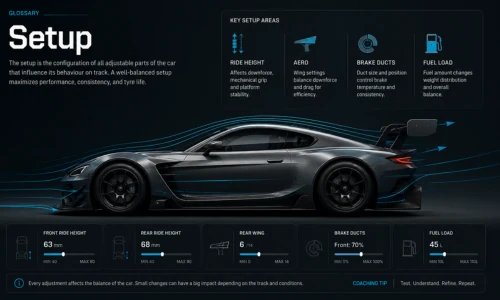 Setup Setup changes how the car behaves under braking, turning and acceleration.
 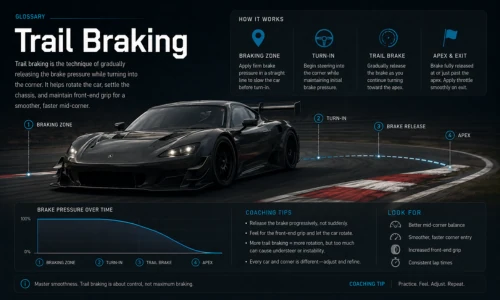 Apex The apex connects braking, rotation and exit speed.
 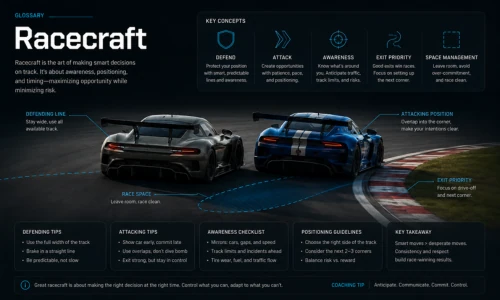 Racecraft Racecraft is about decisions, positioning and control around other cars.
 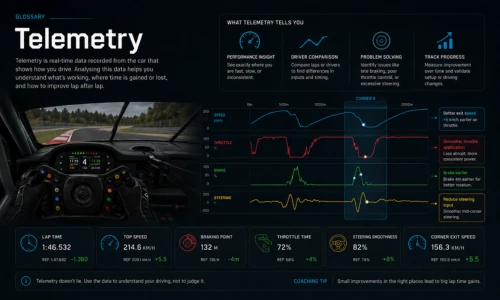 Telemetry Telemetry shows what is happening in your inputs, speed and lap time.
  Stint A stint shows your real race pace, tyre use and consistency.
 Glossary of racing and sim racing terms
Use the search bar or filters to find a term. The explanations are written for sim racers who want to understand racing language, improve their driving and prepare better for coaching, leagues or endurance events.
Tip: search for racing words, sim racing terms or parts of a word. The list filters on this page.
ACC
PlatformsAlso searched as: Assetto Corsa Competizione
ACC stands for Assetto Corsa Competizione. It is a GT racing simulator often used for GT3 and GT4 racing, setup work, league racing and driver coaching.
Assetto Corsa Competizione
PlatformsAlso searched as: ACC
Assetto Corsa Competizione is a racing simulator focused on GT racing. In coaching, it is often used for GT3 car control, racecraft, tyre management and setup direction.
Apex
Driving TechniqueAlso searched as: clipping point, corner apex
The apex is the point near the inside of a corner where the car gets closest to the kerb or inside line. A good apex helps you connect corner entry, rotation and exit speed.
Early apex
Driving TechniqueAlso searched as: early turn-in
An early apex means you reach the inside of the corner too soon. It can make the exit tighter and often costs speed on the next straight.
Late apex
Driving TechniqueAlso searched as: late turn-in
A late apex means you turn in slightly later and reach the inside later in the corner. It often helps with exit speed, traction and overtaking lines.
Racing line
Driving TechniqueAlso searched as: ideal line, driving line
The racing line is the path through a corner that gives the best balance between speed, grip and exit. It is not always the same line in traffic or during a battle.
Braking point
Driving TechniqueAlso searched as: brake point
The braking point is where you start braking before a corner. A good braking point is repeatable and matched to fuel load, tyre condition, car balance and traffic.
Turn-in
Driving TechniqueAlso searched as: corner entry steering
Turn-in is the moment you start steering towards the corner. The timing of turn-in affects rotation, minimum speed and how early you can get back on throttle.
Corner entry
Driving TechniqueAlso searched as: entry phase
Corner entry is the first phase of a corner, from braking to initial rotation. Many mistakes happen here because braking, steering and weight transfer overlap.
Mid-corner
Driving TechniqueAlso searched as: middle of the corner
Mid-corner is the middle phase of the corner, where the car is usually close to its minimum speed. Balance and patience matter here.
Corner exit
Driving TechniqueAlso searched as: exit phase
Corner exit is the final phase of the corner, where you open the steering and apply throttle. A strong exit can gain time all the way down the next straight.
Exit speed
Driving TechniqueAlso searched as: corner exit speed
Exit speed is the speed you carry out of a corner. It matters most before long straights, where a small difference can grow over several seconds.
Minimum speed
Driving TechniqueAlso searched as: minimum corner speed
Minimum speed is the lowest speed reached in a corner. It is useful for analysis, but a higher minimum speed is only valuable if the exit remains strong.
Kerb
Core RacingAlso searched as: curb
A kerb is the raised edge on the inside or outside of a corner. Some kerbs help rotation or track usage, while others unsettle the car.
Chicane
Core RacingAlso searched as: left-right corner, right-left corner
A chicane is a quick sequence of corners, often used to slow cars down. Rhythm, kerb use and exit priority are important in a chicane.
Hairpin
Core RacingAlso searched as: slow corner
A hairpin is a tight, slow corner with a large change of direction. It often rewards strong braking, rotation and traction on exit.
Straight
Core RacingAlso searched as: straightaway
A straight is a section of track with little or no steering input. Exit speed, slipstream and drag often matter most here.
Sector
TelemetryAlso searched as: track sector
A sector is a timing section of a lap. Sector times help show where you gain or lose time around the track.
Lap time
TelemetryAlso searched as: lap, laptime
Lap time is the time it takes to complete one full lap. In coaching, lap time is useful, but the way that time is created matters more.
Delta
TelemetryAlso searched as: delta time
Delta is the time difference between your current lap and a reference lap. It helps show where you gain or lose time in real time.
Split
TelemetryAlso searched as: time split
A split is a timing gap at a specific point on the track. Splits help compare pace between drivers or between laps.
Gap
StrategyAlso searched as: time gap
A gap is the time difference between two cars. It affects race strategy, overtaking chances and pit window decisions.
Interval
StrategyAlso searched as: time interval
Interval usually means the time gap to the car directly ahead or behind. It is useful for race management and pressure control.
Track limits
Race ControlAlso searched as: track limit, off track
Track limits define how much of the car must stay within the legal racing surface. Exceeding them can lead to warnings, invalid laps or penalties.
Clean lap
Core RacingAlso searched as: valid lap
A clean lap is a lap without major mistakes, traffic problems or track limit issues. It is useful for comparing true pace.
Invalid lap
Race ControlAlso searched as: deleted lap, off track lap
An invalid lap is a lap that no longer counts, usually because of track limits or a rule breach. It is common in qualifying and time trials.
Out lap
StrategyAlso searched as: leaving the pits
An out lap is the lap after leaving the pit lane. It is often used to warm tyres and prepare for a flying lap.
In lap
StrategyAlso searched as: returning to pits
An in lap is the lap where you return to the pits. In endurance and league racing, in laps affect pit strategy and stint planning.
Flying lap
Core RacingAlso searched as: push lap
A flying lap is a timed lap after the car is already up to speed. It is common in qualifying and practice runs.
Hot lap
Core RacingAlso searched as: qualifying lap
A hot lap is a full push lap aimed at setting the fastest possible time. It usually has more risk than race pace driving.
Cool-down lap
StrategyAlso searched as: cooldown lap
A cool-down lap is used to reduce tyre, brake or engine stress after a push lap or race. It also helps manage temperatures.
Qualifying lap
StrategyAlso searched as: qualy lap
A qualifying lap is a lap driven to set the best possible starting position. It often prioritises peak grip and risk over long-run consistency.
Race pace
StrategyAlso searched as: long-run pace
Race pace is the speed you can repeat during a race. It is usually more important than one perfect lap.
Qualifying pace
StrategyAlso searched as: single-lap pace
Qualifying pace is the speed you can produce over one or a few push laps. It often differs from race pace because fuel, tyres and risk level are different.
Green track
Core RacingAlso searched as: low grip track
A green track has little rubber on the racing line. Grip is usually lower, and lap times can improve as the track evolves.
Rubbered-in track
Core RacingAlso searched as: track grip
A rubbered-in track has more tyre rubber on the racing line. It usually gives more grip than a green track.
Track evolution
Core RacingAlso searched as: track grip evolution
Track evolution describes how grip changes during a session. Rubber, temperature and weather can all affect it.
Grip
Driving TechniqueAlso searched as: traction, adhesion
Grip is the tyre's ability to hold the road or virtual track. Braking, steering and throttle all use part of the available grip.
Grip limit
Driving TechniqueAlso searched as: limit of grip
The grip limit is the point where the tyres can no longer support the requested braking, steering or throttle. Good driving means staying close to that limit without losing control.
Traction
Driving TechniqueAlso searched as: drive grip
Traction is the grip available for acceleration. Poor traction can cause wheelspin, oversteer or slow exits.
Weight transfer
Driving TechniqueAlso searched as: load transfer
Weight transfer is the shift of load across the car during braking, steering and acceleration. It affects grip, rotation and stability.
Rotation
Driving TechniqueAlso searched as: car rotation
Rotation is how the car turns around its centre while entering or moving through a corner. Good rotation helps the car point towards the exit without excessive sliding.
Car control
Driving TechniqueAlso searched as: vehicle control
Car control is the ability to manage grip, balance and inputs while the car is moving near the limit. It is one of the core skills in sim racing coaching.
Trail braking
Driving TechniqueAlso searched as: brake release
Trail braking is the technique of keeping some brake pressure as you turn into the corner. It helps transfer load to the front tyres and can improve rotation when done correctly.
Threshold braking
Driving TechniqueAlso searched as: maximum braking
Threshold braking means braking close to the maximum grip available before lock-up or ABS intervention. It requires precise pressure and a clean release.
Brake release
Driving TechniqueAlso searched as: brake bleed, releasing the brake
Brake release is how you reduce brake pressure as the car turns into the corner. A smooth release often improves balance and rotation.
Brake modulation
Driving TechniqueAlso searched as: brake control
Brake modulation is the ability to adjust brake pressure precisely instead of treating the brake as on or off. It is important for trail braking and stability.
Left-foot braking
Driving TechniqueAlso searched as: LFB
Left-foot braking means using the left foot for the brake pedal. In sim racing, it can make braking and throttle transitions faster and more controlled.
Throttle control
Driving TechniqueAlso searched as: throttle application
Throttle control is how you apply power on exit or during a corner. Smooth throttle use helps traction, tyre life and stability.
Throttle input
Driving TechniqueAlso searched as: gas input, throttle trace
Throttle input is how much throttle you apply and how quickly you apply it. Smooth throttle input helps traction, balance and corner exit speed.
Steering input
Driving TechniqueAlso searched as: steering trace
Steering input is how much and how quickly you turn the wheel. Too much input can overload the tyres and create understeer or tyre scrub.
Understeer
Driving TechniqueAlso searched as: front push
Understeer happens when the front tyres cannot turn the car as much as the driver asks. The car pushes wide, often because of too much speed, steering or poor balance.
Oversteer
Driving TechniqueAlso searched as: rear slide
Oversteer happens when the rear of the car rotates more than intended. It can help rotation in small amounts, but too much oversteer costs control and speed.
Snap oversteer
Driving TechniqueAlso searched as: sudden oversteer
Snap oversteer is a sudden rear slide that happens quickly and can be hard to catch. It often appears during aggressive throttle, kerb strikes or unstable weight transfer.
Lift-off oversteer
Driving TechniqueAlso searched as: off-throttle oversteer
Lift-off oversteer happens when the rear becomes unstable after lifting off the throttle. It is common when weight moves forward too quickly.
Wheelspin
Driving TechniqueAlso searched as: traction loss
Wheelspin happens when the driven tyres rotate faster than the car is moving. It costs acceleration and can overheat or wear the tyres.
Lock-up
Driving TechniqueAlso searched as: brake lock
A lock-up happens when a tyre stops rotating during braking. It reduces control and can damage tyre performance in sims that model flat spots.
ABS
SetupAlso searched as: anti-lock braking system
ABS helps prevent wheel lock-up under braking. In GT cars, using ABS correctly is part of fast and consistent braking.
Traction control
SetupAlso searched as: TC
Traction control reduces wheelspin by limiting power when the driven tyres lose grip. The best setting depends on car, track, tyres and driving style.
Short shifting
Driving TechniqueAlso searched as: early upshift
Short shifting means shifting up earlier than usual. It can reduce wheelspin, save fuel or stabilise the car on exit.
Engine braking
SetupAlso searched as: off-throttle braking
Engine braking is the slowing effect created by the drivetrain when you lift off throttle or downshift. It can affect rear stability on corner entry.
Coasting
Driving TechniqueAlso searched as: neutral phase
Coasting means the car is neither braking nor accelerating. A small amount can help balance, but too much coasting often costs time.
Trail throttle
Driving TechniqueAlso searched as: maintenance throttle
Trail throttle is a small amount of throttle used to stabilise the car through a corner. It can help balance when full throttle is not yet possible.
Brake trace
TelemetryAlso searched as: brake graph
A brake trace shows how brake pressure changes through a braking zone. It is useful for analysing peak pressure, release shape and trail braking.
Throttle trace
TelemetryAlso searched as: throttle graph
A throttle trace shows how throttle input changes through a lap. It helps identify hesitation, wheelspin risk and exit timing.
Steering trace
TelemetryAlso searched as: steering graph
A steering trace shows steering input over time. It can reveal overdriving, corrections and how smoothly the car is being placed.
Speed trace
TelemetryAlso searched as: speed graph
A speed trace shows speed through each part of the lap. It helps compare braking, minimum speed and exits between laps.
Racecraft
RacecraftAlso searched as: race craft
Racecraft is the skill of racing with other cars. It includes positioning, overtaking, defending, traffic management and making good decisions under pressure.
Overtaking
RacecraftAlso searched as: passing
Overtaking is the act of passing another car. A good overtake needs timing, positioning and enough control to leave racing room.
Defending
RacecraftAlso searched as: defensive driving
Defending means protecting your position from a car behind. Strong defending is firm, predictable and within the rules.
Positioning
RacecraftAlso searched as: car placement
Positioning is where you place the car relative to other drivers and the racing line. Good positioning can create or prevent overtaking chances.
Side-by-side
RacecraftAlso searched as: alongside
Side-by-side racing happens when two cars are next to each other through part of a corner or straight. It requires awareness and space management.
Wheel-to-wheel racing
RacecraftAlso searched as: close racing
Wheel-to-wheel racing means racing closely with another driver. The key is to be competitive without losing control or creating unnecessary contact.
Divebomb
RacecraftAlso searched as: late lunge
A divebomb is a very late braking move to the inside. It can work if control and overlap are clear, but it often creates high risk.
Switchback
RacecraftAlso searched as: cutback
A switchback is a move where you give up the first part of the corner to get a better exit and pass on the way out.
Cutback
RacecraftAlso searched as: switchback
A cutback uses a wider or later line to get better rotation and exit speed after another car runs deep or defends the inside.
Blocking
RacecraftAlso searched as: illegal blocking
Blocking means moving mainly to stop another car rather than to take a normal racing line. Rules vary, but unpredictable blocking is usually risky.
Squeezing
RacecraftAlso searched as: pinching
Squeezing means leaving another driver less space while still trying to stay within the rules. It requires judgement and awareness.
Racing room
RacecraftAlso searched as: racing space
Racing room is the space a driver needs to keep the car on track while racing another car. Leaving enough room reduces contact risk.
Overlap
RacecraftAlso searched as: alongside overlap
Overlap means part of one car is alongside another. It matters for judging rights to space in corners.
Inside line
RacecraftAlso searched as: inside
The inside line is the line closest to the inside of the next corner. It can help defend or attack, but it may compromise exit speed.
Outside line
RacecraftAlso searched as: outside
The outside line is the wider line around a corner. It can give better exit speed or set up a switchback.
Pressure
RacecraftAlso searched as: race pressure
Pressure is the mental and tactical effect of another car being close. Good drivers keep decisions clean when pressure increases.
Traffic management
RacecraftAlso searched as: traffic
Traffic management is the ability to handle slower cars, faster cars and multiclass situations without losing too much time.
Lapping
RacecraftAlso searched as: putting a car a lap down
Lapping is when a faster car catches a car that is one or more laps behind. Clear communication and predictable driving matter.
Multiclass traffic
RacecraftAlso searched as: multi-class traffic
Multiclass traffic happens when faster and slower car classes share the same race. It rewards patience, planning and awareness.
Risk management
RacecraftAlso searched as: risk control
Risk management is choosing when to push, defend, attack or wait. It is often what separates a fast driver from a consistent race driver.
Patience
RacecraftAlso searched as: waiting for the move
Patience means not forcing a move too early. In racing, waiting one corner longer can be faster and safer.
Unsafe rejoin
Race ControlAlso searched as: unsafe track rejoin
An unsafe rejoin happens when a car returns to the track without leaving enough space or checking traffic. It can cause avoidable incidents.
Contact
RacecraftAlso searched as: car contact
Contact is physical contact between cars. In sim racing it can damage the car, create penalties or ruin race rhythm.
Incident
Race ControlAlso searched as: race incident
An incident is an event such as contact, a spin, an off-track or unsafe driving. Different platforms record and judge incidents in different ways.
Avoidable contact
Race ControlAlso searched as: avoidable collision
Avoidable contact is contact that a driver could reasonably have prevented. Race stewards and platforms may penalise it.
Racing etiquette
RacecraftAlso searched as: driving etiquette
Racing etiquette is the expected behaviour between drivers. It includes predictable driving, leaving space and respecting blue flags or race control.
Awareness
RacecraftAlso searched as: spatial awareness
Awareness is knowing where other cars are and what they may do next. It is crucial in close racing, starts and multiclass traffic.
Stint
StrategyAlso searched as: race stint
A stint is a continuous period of driving between pit stops or driver changes. In endurance racing, stint planning affects tyres, fuel and consistency.
Pit stop
StrategyAlso searched as: pitstop, pitting, pit lane stop
A pit stop is when you enter the pits for fuel, tyres, repairs, driver swap or penalties. A clean pit stop can decide races.
Pit window
StrategyAlso searched as: strategy window
The pit window is the period in which stopping is allowed or strategically useful. It matters in races with fuel, tyre or mandatory pit rules.
Pit strategy
StrategyAlso searched as: race strategy
Pit strategy is the plan for when to stop, what to change and how to manage track position. It depends on fuel, tyres, traffic and race length.
Lift and coast
StrategyAlso searched as: lift-and-coast, fuel saving
Lift and coast means lifting off the throttle before the braking zone and letting the car roll for a short distance. It is used to save fuel, reduce stress on tyres or manage the car more smoothly.
Undercut
StrategyAlso searched as: early pit stop
An undercut is a strategy where you pit earlier to gain time on fresh tyres or clear track. It works only if the new stint is faster enough.
Overcut
StrategyAlso searched as: late pit stop
An overcut is a strategy where you stay out longer than a rival. It can work if you have clean air, better tyre life or the rival loses time.
Splash and dash
StrategyAlso searched as: short fuel stop
A splash and dash is a short pit stop mainly for a small amount of fuel. It is used when only a little fuel is needed to finish.
Fuel saving
StrategyAlso searched as: fuel save
Fuel saving means driving in a way that uses less fuel. It can include short shifting, lifting earlier and reducing throttle use.
Tyre saving
TyresAlso searched as: tyre management
Tyre saving means driving to reduce tyre wear or temperature. It often requires smoother inputs and less sliding.
Double stint
StrategyAlso searched as: double-stinting
A double stint means using the same set of tyres or same driver stint for two race segments, depending on the rules. It is common in endurance strategy.
Driver swap
StrategyAlso searched as: driver change
A driver swap is when one driver takes over from another during a race. It is important in endurance racing and team events.
Endurance race
StrategyAlso searched as: endurance
An endurance race is a long race where consistency, traffic, pit stops, strategy and mental focus matter as much as raw speed.
Sprint race
StrategyAlso searched as: short race
A sprint race is a shorter race with less time to recover from mistakes. Qualifying, starts and early race decisions become more important.
Safety car
Race ControlAlso searched as: SC
A safety car controls the field during dangerous conditions or incidents. In sim racing, safety car rules depend on the platform and event.
Virtual safety car
Race ControlAlso searched as: VSC
A virtual safety car slows the field without a physical safety car. Drivers usually need to follow a target speed or delta.
Full course yellow
Race ControlAlso searched as: FCY
Full course yellow means the whole track is under caution. Rules differ by series, but overtaking is usually restricted.
Formation lap
Race ControlAlso searched as: formation
A formation lap is a lap before the race start where cars form up and prepare for the start. It is common in rolling starts and some league events.
Rolling start
Race ControlAlso searched as: rolling grid
A rolling start begins while the cars are moving. Spacing, throttle control and discipline matter before green.
Standing start
Race ControlAlso searched as: grid start
A standing start begins from a stationary grid position. Launch control, reaction and avoiding contact are key.
Restart
Race ControlAlso searched as: race restart
A restart is when racing resumes after a caution, safety car or red flag. Good restarts require timing and awareness.
Drive-through penalty
Race ControlAlso searched as: drive-through
A drive-through penalty requires a driver to pass through the pit lane without stopping. It costs time but is usually less severe than a stop-go.
Stop-go penalty
Race ControlAlso searched as: stop and go
A stop-go penalty requires a driver to stop in the pits for a set time before continuing. It is often given for more serious rule breaches.
Penalty
Race ControlAlso searched as: race penalty
A penalty is a punishment for breaking rules or causing incidents. It can be time added, a drive-through, a stop-go or disqualification.
Track position
StrategyAlso searched as: position on track
Track position is where you are relative to other cars on the road. It matters even when another strategy may be faster on paper.
Strength of field
PlatformsAlso searched as: SOF
Strength of field is a measure of how strong a race grid is, often based on driver ratings. In iRacing, it helps describe the level of competition.
Fuel load
SetupAlso searched as: fuel weight
Fuel load is the amount of fuel in the car. More fuel adds weight and can change braking, tyre wear and lap time.
Fuel usage
TelemetryAlso searched as: fuel consumption
Fuel usage is how much fuel the car uses per lap or stint. It is important for endurance racing and pit strategy.
Setup
SetupAlso searched as: car setup, sim racing setup
A setup is the group of car settings used for a track, car and driving style. It can affect balance, tyre behaviour, braking and confidence.
Sim racing setup
SetupAlso searched as: racing simulator setup, racing sim setup
A sim racing setup can mean car setup or hardware setup. On this page, the context decides whether it means vehicle settings or your wheel, pedals and rig.
ACC setup
SetupAlso searched as: Assetto Corsa Competizione setup
An ACC setup is a car setup for Assetto Corsa Competizione. It can include tyre pressure, brake bias, wing, ride height, dampers and more.
Car balance
SetupAlso searched as: balance
Car balance describes whether the car feels stable, understeery, oversteery or neutral. Good balance gives confidence and makes driving more repeatable.
Brake bias
SetupAlso searched as: brake balance
Brake bias sets how braking force is distributed between the front and rear brakes. More front bias can add stability, while more rear bias can help rotation but increase risk.
Brake temperature
SetupAlso searched as: brake temps
Brake temperature is the heat in the brakes. Brakes that are too cold or too hot can reduce performance and consistency.
Brake ducts
SetupAlso searched as: brake cooling
Brake ducts control airflow to the brakes. More cooling can reduce temperature, but too much cooling can keep brakes too cold and may reduce aerodynamic efficiency or braking performance.
Tyre pressure
TyresAlso searched as: tire pressure
Tyre pressure affects grip, temperature, wear and balance. The right pressure depends on the sim, car, track and stint conditions.
Tyre temperature
TyresAlso searched as: tire temperature, tyre temps
Tyre temperature shows how hot the tyres are. It helps explain grip, wear and whether pressure or driving style may need adjustment.
Tyre wear
TyresAlso searched as: tire wear
Tyre wear is the loss of tyre performance over distance. Sliding, overheating and aggressive inputs can increase wear.
Tyre degradation
TyresAlso searched as: tire degradation, deg
Tyre degradation is the performance loss as tyres age during a stint. It can affect braking, cornering and consistency.
Tyre compound
TyresAlso searched as: compound
A tyre compound is a type of tyre with a specific grip and durability profile. Not every sim or series gives multiple compounds.
Camber
SetupAlso searched as: wheel camber
Camber is the angle of the wheel relative to the vertical. It affects how the tyre contacts the track during cornering.
Caster
SetupAlso searched as: steering caster
Caster is a suspension angle that affects steering feel, stability and how the tyre gains camber while turning.
Toe
SetupAlso searched as: toe in, toe out
Toe is the angle of the wheels pointing slightly inward or outward. It affects stability, response and tyre wear.
Ride height
SetupAlso searched as: car height
Ride height is how high the car sits above the track. It affects aerodynamics, kerb behaviour and bottoming risk.
Rake
SetupAlso searched as: front rear ride height difference
Rake is the difference between front and rear ride height. It can affect aerodynamic balance and car behaviour.
Wing
SetupAlso searched as: rear wing, aero wing
Wing settings change downforce and drag. More wing usually gives more high-speed grip but less straight-line speed.
Splitter
SetupAlso searched as: front splitter
A splitter is an aerodynamic part at the front of the car. It helps create front downforce, especially at speed.
Diffuser
SetupAlso searched as: rear diffuser
A diffuser helps manage airflow under the car and create downforce. Its effect depends on ride height and car design.
Downforce
SetupAlso searched as: aero grip
Downforce is aerodynamic force pushing the car into the track. It increases grip at speed but often adds drag.
Drag
SetupAlso searched as: air resistance
Drag is aerodynamic resistance that slows the car down. Reducing drag can improve top speed, but may reduce downforce.
Aero balance
SetupAlso searched as: aerodynamic balance
Aero balance is the distribution of aerodynamic grip between the front and rear of the car. It mainly affects stability, turn-in and grip in medium and high-speed corners.
Mechanical grip
SetupAlso searched as: low-speed grip
Mechanical grip comes from tyres, suspension and weight transfer rather than aerodynamics. It matters most in slower corners.
Damper
SetupAlso searched as: shock absorber
A damper controls how quickly the suspension moves. Damper settings can affect kerb behaviour, stability and response.
Bump
SetupAlso searched as: compression damping
Bump controls how the damper reacts when the suspension compresses. It can affect braking, kerbs and weight transfer.
Rebound
SetupAlso searched as: extension damping
Rebound controls how the damper reacts when the suspension extends. It can affect stability and how the car settles after load changes.
Bumpstop
SetupAlso searched as: bump stop
A bumpstop limits suspension travel. In some cars, it strongly affects ride height, aero platform and kerb behaviour.
Anti-roll bar
SetupAlso searched as: ARB, sway bar
An anti-roll bar connects the left and right suspension. It affects roll stiffness and the balance between front and rear grip.
Spring rate
SetupAlso searched as: springs
Spring rate describes how stiff the suspension springs are. Stiffer springs can improve response but may reduce grip over bumps.
Differential
SetupAlso searched as: diff
The differential controls how the driven wheels rotate relative to each other. It affects traction, rotation and stability.
Preload
SetupAlso searched as: diff preload
Preload is a differential setting that affects how early the diff starts locking. It can change corner entry, mid-corner and exit behaviour.
Gear ratio
SetupAlso searched as: gearing
Gear ratio affects acceleration and top speed. Shorter gearing improves acceleration, while longer gearing can improve top speed.
Engine map
SetupAlso searched as: ECU map, power map
An engine map changes how the engine delivers power or uses fuel. In some cars it affects fuel saving, throttle response or race strategy.
ECU map
SetupAlso searched as: engine map
ECU map is another term for engine map. It can affect power delivery, fuel use or drivability depending on the sim and car.
BoP
PlatformsAlso searched as: Balance of Performance
BoP stands for Balance of Performance. It is used to adjust different cars so they can race more closely together.
Balance of Performance
PlatformsAlso searched as: BoP
Balance of Performance is a system that adjusts car performance through weight, power or other limits. It aims to keep different car models competitive.
Ballast
SetupAlso searched as: added weight
Ballast is extra weight added to a car. It can be used for balance, rules or performance equalisation.
Restrictor
SetupAlso searched as: air restrictor
A restrictor limits engine airflow or power. It is sometimes used in performance balancing.
Aero platform
SetupAlso searched as: aerodynamic platform
The aero platform is how the car maintains its ride height and attitude at speed. A stable platform helps predictable downforce.
Bottoming
SetupAlso searched as: bottoming out
Bottoming happens when the car hits the ground or reaches the end of suspension travel. It can reduce grip and upset the car.
Kerb strike
Driving TechniqueAlso searched as: hitting the kerb
A kerb strike happens when the car hits a kerb hard enough to disturb balance. Some kerbs can be used, while others should be avoided.
Telemetry
TelemetryAlso searched as: data
Telemetry is recorded data from the car and driver inputs. It can show braking, throttle, speed, steering and other details that are hard to judge by feel.
Data analysis
TelemetryAlso searched as: sim racing data
Data analysis means using telemetry, lap times and driving traces to understand where time is gained or lost.
Replay analysis
TelemetryAlso searched as: replay review
Replay analysis means reviewing video or in-game replay to study line choice, traffic, mistakes and car placement.
Inputs
TelemetryAlso searched as: driver inputs
Inputs are what the driver does with brake, throttle, steering and gears. Input quality often explains consistency and car control.
Reference lap
TelemetryAlso searched as: comparison lap
A reference lap is a lap used for comparison. It can be your best lap, a coach's lap or another driver's lap.
Comparison lap
TelemetryAlso searched as: lap comparison
A comparison lap is used against another lap to identify differences in braking, speed, line and throttle.
Braking zone
Driving TechniqueAlso searched as: brake zone
The braking zone is the section of track where the car slows before a corner. It is one of the best places to find time in analysis.
Throttle application
Driving TechniqueAlso searched as: applying throttle
Throttle application describes when and how you start adding power. It affects traction, exit speed and tyre wear.
Vmax
TelemetryAlso searched as: top speed, maximum speed
Vmax means maximum speed reached on a straight or section. It can be influenced by setup, slipstream, exit speed and drag.
GPS line
TelemetryAlso searched as: driving line data
A GPS line shows the path of the car around the circuit in data tools. It helps compare line choice and track usage.
MoTeC
TelemetryAlso searched as: Motec data
MoTeC is a data analysis tool used by many sim racers and real racing teams. In sim racing, it is often used to review telemetry from compatible platforms.
Stint analysis
TelemetryAlso searched as: long-run analysis
Stint analysis looks at performance over many laps instead of one lap. It helps with tyre wear, consistency and race pace.
Tyre data
TelemetryAlso searched as: tire data
Tyre data can include pressure, temperature and wear. It helps explain changing grip and balance during a stint.
Fuel data
TelemetryAlso searched as: fuel numbers
Fuel data shows usage, remaining fuel and sometimes predicted laps. It is important for race planning and endurance events.
Consistency analysis
TelemetryAlso searched as: lap consistency
Consistency analysis looks at how stable your lap times and mistakes are over multiple laps. It is often more useful than only studying the fastest lap.
Average lap time
TelemetryAlso searched as: average pace
Average lap time shows your normal pace over a run. It is often a better race indicator than one peak lap.
Variance
TelemetryAlso searched as: lap time spread
Variance describes how much your lap times change. Lower variance usually means better repeatability.
Optimal lap
TelemetryAlso searched as: optimum lap
An optimal lap combines your best sector or mini-sector times. It shows potential, but it may not be realistic if the sectors came from different conditions.
Theoretical best
TelemetryAlso searched as: theoretical lap
Theoretical best is the fastest lap possible from your best segments. It can show potential pace, but it does not always reflect race consistency.
Sector time
TelemetryAlso searched as: sector split
Sector time is the time recorded for one sector of the track. It helps identify which part of the lap needs work.
Live timing
TelemetryAlso searched as: timing screen
Live timing shows current lap times, gaps, positions and session information. It is useful for practice, qualifying and race management.
Delta bar
TelemetryAlso searched as: delta display
A delta bar shows time gained or lost against a reference. It can help with feedback, but watching it too much can distract from driving.
Driver input
TelemetryAlso searched as: input, pedal input, steering input
Driver input is the combined action from steering, brake, throttle, clutch and shifting. In coaching and telemetry, inputs show how the driver controls the car.
Input overlay
TelemetryAlso searched as: pedal overlay
An input overlay shows brake, throttle, clutch and steering inputs on screen. It is useful for coaching and self-review.
Brake pressure
TelemetryAlso searched as: braking force
Brake pressure is how hard you press the brake. Analysing it helps with threshold braking, trail braking and repeatability.
Pedal trace
TelemetryAlso searched as: pedal graph
A pedal trace shows brake and throttle inputs over time. It helps identify abrupt inputs, hesitation or poor release timing.
Wheelbase
HardwareAlso searched as: steering base, DD base
A wheelbase is the motor unit the steering wheel is mounted to. In sim racing, it has a large effect on force feedback strength, precision and steering feel.
Direct drive
HardwareAlso searched as: DD wheelbase
Direct drive means the steering wheel is driven directly by the motor. It usually gives stronger and more detailed force feedback than belt or gear systems.
Force feedback
HardwareAlso searched as: FFB
Force feedback is the resistance and information sent through the steering wheel. It helps you feel grip, kerbs, slides and car behaviour.
FFB clipping
HardwareAlso searched as: force feedback clipping
FFB clipping happens when the wheelbase reaches its output limit and cannot show stronger forces. It can hide detail and make feedback less useful.
Torque
HardwareAlso searched as: wheel torque
Torque is rotational force from the wheelbase. Higher torque can give stronger feedback, but settings still need control and comfort.
Oscillation
HardwareAlso searched as: wheel oscillation
Oscillation is unwanted shaking or movement in the wheel, often on straights. It can come from FFB settings, damping or hardware behaviour.
Steering lock
HardwareAlso searched as: wheel rotation
Steering lock is the maximum steering angle available. It should match the car and sim settings for accurate control.
Steering ratio
HardwareAlso searched as: steering sensitivity
Steering ratio describes how steering wheel movement translates to front wheel angle. It affects response and precision.
Load cell pedals
HardwareAlso searched as: load cell brake
Load cell pedals measure braking force rather than only pedal travel. They can make braking more repeatable.
Pedal calibration
HardwareAlso searched as: calibrating pedals
Pedal calibration sets the range and response of pedals. Poor calibration can make braking or throttle control inconsistent.
Brake force
HardwareAlso searched as: brake pedal force
Brake force is how much pressure is needed to reach full braking. Matching it to your hardware and strength helps consistency.
Throttle pedal
HardwareAlso searched as: accelerator pedal
The throttle pedal controls power delivery. Smooth throttle input is important for traction and corner exits.
Clutch pedal
HardwareAlso searched as: clutch
A clutch pedal is used for starts, shifting or older cars depending on the sim. Many modern GT cars do not need it during normal shifts.
Shifter
HardwareAlso searched as: gear shifter
A shifter is a hardware control for changing gears. It can be sequential or H-pattern depending on the setup.
Paddle shifter
HardwareAlso searched as: paddles
Paddle shifters are gear controls mounted behind the wheel. They are common in GT, prototype and formula-style sim cars.
Handbrake
HardwareAlso searched as: sim handbrake
A handbrake is mostly used in rally or drifting. It is less relevant for GT racing but useful in some disciplines.
Button box
HardwareAlso searched as: control box
A button box gives extra physical controls for functions such as ignition, pit limiter, brake bias and black box navigation.
Sim rig
HardwareAlso searched as: cockpit, racing rig
A sim rig is the frame or cockpit that holds the seat, wheelbase and pedals. A stable rig helps braking and steering consistency.
Cockpit
HardwareAlso searched as: racing cockpit
A cockpit is the seating and hardware structure of a sim racing setup. It can range from a basic stand to a full aluminium profile rig.
Monitor
HardwareAlso searched as: screen
A monitor is the display used for sim racing. Size, refresh rate and position affect visibility and immersion.
Triple screen
HardwareAlso searched as: triples
Triple screen means using three monitors for a wider field of view. It helps awareness but needs space and correct setup.
Ultrawide
HardwareAlso searched as: wide monitor
An ultrawide monitor gives a wider view than a normal monitor without using three screens. It is a common middle ground for sim racing.
VR
HardwareAlso searched as: virtual reality
VR stands for virtual reality. It can improve depth perception and immersion, but comfort and performance depend on hardware and settings.
Field of view
HardwareAlso searched as: FOV
Field of view is how much of the world is shown on screen. Correct FOV helps judge speed, distance and corner positioning.
FOV
HardwareAlso searched as: field of view
FOV stands for field of view. In sim racing, a correct FOV can make braking points, apexes and distance judgement more natural.
Seating position
HardwareAlso searched as: seat position
Seating position affects comfort, pedal control and steering consistency. A stable, repeatable position helps long sessions.
Wheel rim
HardwareAlso searched as: steering wheel rim
A wheel rim is the physical steering wheel attached to the wheelbase. Shape and size should fit the car type and driver preference.
Quick release
HardwareAlso searched as: QR
A quick release lets you remove or change wheel rims quickly. It is common on higher-end sim racing systems.
Haptic feedback
HardwareAlso searched as: vibration feedback
Haptic feedback uses vibration or movement to add information through pedals, seats or other hardware. It can help with lock-up, ABS or traction cues.
Bass shaker
HardwareAlso searched as: tactile transducer
A bass shaker adds vibration to a rig or seat. It can simulate kerbs, engine vibration, road texture or tyre effects depending on software.
Motion rig
HardwareAlso searched as: motion simulator
A motion rig moves the cockpit to simulate forces and movement. It can add immersion, but correct settings are important.
Load cell brake
HardwareAlso searched as: load cell pedal
A load cell brake measures pressure instead of only pedal position. It often helps drivers brake more consistently.
iRacing
PlatformsAlso searched as: iracing
iRacing is an online racing simulator with rating systems, official races and licence progression. It is often used for competitive online racing.
Safety Rating
PlatformsAlso searched as: SR
Safety Rating is an iRacing measure linked to incidents over corners driven. It rewards clean driving and affects licence progression.
iRating
PlatformsAlso searched as: IR
iRating is iRacing's driver skill rating. It helps split drivers into fields and measure competitive level.
Incident points
PlatformsAlso searched as: incident count, x points
Incident points are recorded for off-tracks, contact, spins or other incidents in platforms such as iRacing. They affect safety systems and race results.
Licence class
PlatformsAlso searched as: license class
Licence class is a progression level in some racing platforms. It can decide which series or races a driver can enter.
MPR
PlatformsAlso searched as: Minimum Participation Requirements
MPR stands for Minimum Participation Requirements in iRacing. It relates to licence progression and required official race participation.
Official race
PlatformsAlso searched as: official session
An official race is a race recognised by the platform for ratings or progression. In iRacing, official sessions can affect iRating and Safety Rating.
Hosted race
PlatformsAlso searched as: hosted session
A hosted race is a custom race session created by a user or organiser. It may have different rules from official sessions.
League race
PlatformsAlso searched as: league racing
A league race is organised by a community, team or series. League racing often has its own rules, stewarding and calendar.
League racing
PlatformsAlso searched as: online league, community racing
League racing means racing in an organised series with fixed rules, a calendar and often regular competitors. It is usually more structured than open public lobbies.
Practice
PlatformsAlso searched as: practice session
Practice is a session used to learn the track, test setup and build consistency. It is where structured improvement should happen.
Qualifying
StrategyAlso searched as: qualy
Qualifying decides starting position. It rewards clean execution, tyre preparation and peak single-lap pace.
Time trial
PlatformsAlso searched as: TT
Time trial is a mode focused on setting clean lap times under controlled conditions. It is useful for practice but does not include racecraft.
Le Mans Ultimate
PlatformsAlso searched as: LMU
Le Mans Ultimate is a racing simulator focused on endurance racing and modern sportscar racing. It is often linked with Hypercar, LMP2 and GT racing.
LMU
PlatformsAlso searched as: Le Mans Ultimate
LMU stands for Le Mans Ultimate. It is relevant for endurance practice, prototype racing and telemetry-based learning.
rFactor 2
PlatformsAlso searched as: rF2
rFactor 2 is a racing simulator known for detailed vehicle dynamics and endurance content. Some sim racers use it for prototype and GT racing.
Assetto Corsa
PlatformsAlso searched as: AC
Assetto Corsa is a racing simulator with a large modding community. It is different from Assetto Corsa Competizione.
GT3
PlatformsAlso searched as: GT3 car
GT3 is a popular racing car class used in real motorsport and sim racing. GT3 cars often have ABS, traction control and strong endurance use.
GT4
PlatformsAlso searched as: GT4 car
GT4 is a racing class generally slower and less aerodynamically complex than GT3. It can be useful for learning racecraft and car control.
GTE
PlatformsAlso searched as: GTE car
GTE is a former endurance GT class used in major sportscar racing. Some simulators still include GTE cars.
LMP2
PlatformsAlso searched as: prototype
LMP2 is a prototype class used in endurance racing. It is faster than GT cars and requires strong traffic management.
LMDh
PlatformsAlso searched as: prototype hybrid
LMDh is a modern top-level prototype category. It appears in endurance racing and is related to Hypercar competition.
Hypercar
PlatformsAlso searched as: Le Mans Hypercar
Hypercar is a top-level endurance racing category. In sim racing it usually means fast prototypes with high downforce and strong braking.
Formula car
PlatformsAlso searched as: single-seater
A formula car is an open-wheel single-seater. It usually rewards precision, aerodynamic grip and fast reactions.
Touring car
PlatformsAlso searched as: touring racing
A touring car is based on road-car style racing. It often involves close racing and robust racecraft.
Multiclass racing
RacecraftAlso searched as: multi-class racing
Multiclass racing means different car classes race on the same track at the same time. It creates traffic, speed differences and strategy challenges.
Split race
PlatformsAlso searched as: race split
A split race is one of several race fields created when many drivers register. Splits usually group drivers by rating or performance.
Rating system
PlatformsAlso searched as: driver rating
A rating system ranks drivers by skill, safety or results. Each platform uses its own method.
Yellow flag
Race ControlAlso searched as: caution flag
A yellow flag warns of danger on or near the track. In many series, drivers must slow down and avoid overtaking in the affected zone.
Double yellow
Race ControlAlso searched as: double waved yellow
Double yellow usually means a more serious hazard. It often requires greater caution and no overtaking in the zone.
Blue flag
Race ControlAlso searched as: blue flags
A blue flag tells a driver that a faster car is approaching, often because they are being lapped. The exact obligation depends on the series or platform.
Green flag
Race ControlAlso searched as: green
A green flag means racing conditions are clear or that a caution zone has ended. It is also used to start or restart sessions.
Red flag
Race ControlAlso searched as: session stopped
A red flag stops or suspends a session because of serious danger or conditions. In sim racing, use depends on event rules and platform tools.
Black flag
Race ControlAlso searched as: black flag penalty
A black flag usually means a driver must serve a penalty or return to the pits. The exact meaning depends on the series or simulator.
White flag
Race ControlAlso searched as: slow vehicle flag
A white flag can warn of a slow vehicle on track, depending on the series. In some contexts it also marks the final lap.
Chequered flag
Race ControlAlso searched as: checkered flag
The chequered flag marks the end of a session or race. Drivers usually finish the current lap or follow platform instructions.
Yellow-red flag
Race ControlAlso searched as: slippery surface flag
A yellow-red flag warns of a slippery surface, debris or reduced grip. It tells drivers to be careful with traction and line choice.
Slippery surface flag
Race ControlAlso searched as: yellow-red flag
A slippery surface flag warns that grip may be reduced because of oil, water, debris or other track conditions.
Marshal
Race ControlAlso searched as: track marshal
A marshal is a race official who helps signal incidents and manage track safety. In sim racing, marshals may be real stewards or automated systems.
Steward
Race ControlAlso searched as: race steward
A steward reviews incidents and rule breaches. In leagues, stewards often decide penalties after a protest or race review.
Race director
Race ControlAlso searched as: event control
The race director controls the running of an event. This can include starts, cautions, penalties and race procedure.
Pit lane
Race ControlAlso searched as: pits
The pit lane is the controlled lane used for pit stops, repairs and serving some penalties. Speed limits usually apply.
Slow zone
Race ControlAlso searched as: limited speed zone
A slow zone is a section of track where drivers must reduce speed. It is more common in endurance-style rules or organised events.
Track limits warning
Race ControlAlso searched as: track warning
A track limits warning tells a driver they have exceeded track limits too often or too severely. Further breaches can lead to penalties.
Sim racing coaching
CoachingAlso searched as: driver coaching
Sim racing coaching helps a driver improve through feedback, analysis and structured practice. At ABEX Works, it focuses on driving technique, racecraft, data and consistency.
Performance coaching
CoachingAlso searched as: 1-on-1 coaching
Performance coaching focuses on turning driving feedback into measurable improvement. It looks at technique, decision-making, focus and repeatability.
Driver coaching
CoachingAlso searched as: racing coach
Driver coaching is personal guidance aimed at improving the driver's decisions, technique and consistency. It is different from only downloading a setup.
Online coaching
CoachingAlso searched as: remote coaching
Online coaching is coaching done through voice, screen share, replay, data or live driving. It allows ABEX Works to work with drivers internationally.
Practice plan
CoachingAlso searched as: training plan
A practice plan sets clear focus points for a session or week. It prevents random laps and helps improvement become more structured.
Training focus
CoachingAlso searched as: focus point
Training focus is the specific skill you work on during practice. Examples include brake release, apex choice, traffic or consistency.
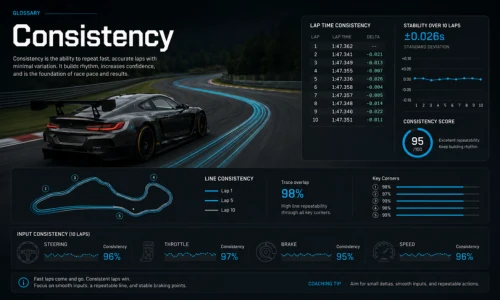
Consistency
CoachingAlso searched as: repeatability
Consistency means producing stable lap times and fewer mistakes over multiple laps. It is often more valuable in races than one peak lap.
Repeatability
CoachingAlso searched as: repeatable pace
Repeatability means being able to reproduce the same inputs, lines and pace. It is one of the main goals of structured practice.
Confidence
CoachingAlso searched as: driver confidence
Confidence is trust in the car, inputs and decisions. It grows when the driver understands what is happening and has a clear training focus.
Race preparation
CoachingAlso searched as: event preparation
Race preparation means preparing for a specific race, league or endurance event. It can include strategy, practice priorities, setup, fuel and mental focus.
Mental focus
CoachingAlso searched as: concentration
Mental focus is the ability to stay concentrated and make good decisions under pressure. It matters in qualifying, battles and long stints.
Mistake recovery
CoachingAlso searched as: recovering from mistakes
Mistake recovery is how quickly you regain rhythm after an error. Good recovery prevents one mistake from becoming several.
Learning curve
CoachingAlso searched as: improvement curve
A learning curve describes how quickly a driver improves. Good coaching makes the learning process clearer and more efficient.
Driver development
CoachingAlso searched as: development
Driver development is the long-term improvement of skill, awareness and consistency. It is broader than one lap time or one setup change.
Feedback
CoachingAlso searched as: coaching feedback
Feedback is useful only when it leads to a clear action. Good feedback explains what happened, why it happened and what to train next.
Focus point
CoachingAlso searched as: coaching point
A focus point is one specific thing to work on. Clear focus points make practice more effective.
Structured training
CoachingAlso searched as: structured practice
Structured training means practising with a plan instead of driving random laps. It helps connect feedback to improvement.
Race review
CoachingAlso searched as: post-race review
A race review looks back at decisions, pace, incidents and strategy after a race. It helps turn experience into better future preparation.
Coaching session
CoachingAlso searched as: training session
A coaching session is a planned session focused on specific improvement points. It can include live driving, replay, telemetry or discussion.
Abe Santema
CoachingAlso searched as: Abe, ABEX Works coach
Abe Santema is the driver and coach behind ABEX Works. His coaching combines racing experience, practical feedback and structured driver development.
ABEX Works
CoachingAlso searched as: Abe Santema coaching
ABEX Works is a sim racing coaching and support project by Abe Santema. It helps drivers improve pace, consistency, racecraft and preparation.
Professional sim racing coach
CoachingAlso searched as: sim racing mentor
A professional sim racing coach helps drivers improve through structured feedback and analysis. The best coaching focuses on the driver's own inputs and decisions.
FIA Motorsport Games
CoachingAlso searched as: Motorsport Games
The FIA Motorsport Games are an international motorsport event with national representation. For ABEX Works, this background supports credibility and racing experience.
Dutch champion
CoachingAlso searched as: Dutch ACC champion
Dutch champion refers to Abe's competitive background in sim racing. It supports the coaching because the feedback comes from real competitive experience.
Aquaplaning
Driving TechniqueAlso searched as: hydroplaning
Aquaplaning happens when a tyre loses contact with the track because of water. In sims with wet weather, it can cause sudden loss of control.
Wet line
Driving TechniqueAlso searched as: rain line
The wet line is the line used in wet conditions. It may avoid rubbered-in areas and use parts of the track with more grip.
Drying line
Core RacingAlso searched as: dry line
A drying line is the part of a wet track that dries first. It often becomes faster as cars drive over it.
Track temperature
TyresAlso searched as: track temp
Track temperature affects tyre pressure, grip and wear. A hot track can increase tyre temperature and change balance.
Air temperature
TyresAlso searched as: ambient temperature
Air temperature can affect engine performance, tyre pressures and track conditions depending on the simulator.
Wind
Core RacingAlso searched as: wind direction
Wind can affect braking points, top speed and car balance in sims that model it. Headwind and tailwind can change references.
Cloud cover
Core RacingAlso searched as: weather
Cloud cover can reduce track temperature and change grip. Weather changes are important in longer sessions.
Dynamic weather
Core RacingAlso searched as: changing weather
Dynamic weather means conditions can change during a session. It affects tyre choice, visibility, grip and strategy.
Rain tyres
TyresAlso searched as: wet tyres
Rain tyres are designed for wet conditions. They give better grip in water but can overheat or wear quickly on a drying track.
Slick tyres
TyresAlso searched as: dry tyres
Slick tyres are tyres without tread, used in dry conditions. They offer high grip on a dry track but perform poorly in standing water.
Flat spot
TyresAlso searched as: flatspot
A flat spot is tyre damage caused by a lock-up, in sims that model it. It can create vibration and reduce performance.
Blistering
TyresAlso searched as: tyre blistering
Blistering is tyre damage caused by excessive heat or stress. It can reduce grip and consistency where modelled.
Graining
TyresAlso searched as: tyre graining
Graining happens when the tyre surface tears and forms a rough layer. It can reduce grip until the surface cleans up or the tyre stabilises.
Tyre scrub
TyresAlso searched as: scrubbing
Tyre scrub is sliding or dragging the tyre across the track. Too much scrub costs speed and increases heat or wear.
Cold tyres
TyresAlso searched as: cold tires
Cold tyres have reduced grip and can make the car feel unstable. Out laps and starts require caution.
Hot tyres
TyresAlso searched as: overheated tyres
Hot tyres can lose grip and become inconsistent. Smooth driving and pressure management can help.
Optimal pressure
TyresAlso searched as: target pressure
Optimal pressure is the pressure range where tyres work best in a given sim and car. It changes with track temperature and stint conditions.
Tyre window
TyresAlso searched as: operating window
The tyre window is the temperature or pressure range where a tyre performs well. Staying in the window improves consistency.
Tyre management
TyresAlso searched as: tire management
Tyre management is controlling wear, temperature and grip over a stint. It is essential in endurance and longer league races.
Brake balance adjustment
SetupAlso searched as: bias adjustment
Brake balance adjustment means changing brake bias during a session or race. It can help as fuel burns off or tyres change.
Differential locking
SetupAlso searched as: diff locking
Differential locking describes how strongly the driven wheels are connected. It affects traction and rotation.
Dirty air
RacecraftAlso searched as: turbulent air
Dirty air is turbulent airflow behind another car. It can reduce front grip and increase tyre sliding in aero-sensitive cars.
Clean air
RacecraftAlso searched as: undisturbed air
Clean air is airflow without another car directly ahead. Cars usually have better downforce and tyre performance in clean air.
Slipstream
RacecraftAlso searched as: draft
Slipstream is the reduced air resistance behind another car. It can help a following car gain speed on a straight.
Drafting
RacecraftAlso searched as: slipstreaming
Drafting means using another car's slipstream to reduce drag and gain speed. It is useful for overtaking and fuel saving.
Push to pass
StrategyAlso searched as: P2P
Push to pass is a temporary power boost in some racing formats. Availability and rules depend on the car, sim or series.
DRS
StrategyAlso searched as: drag reduction system
DRS is a drag reduction system used in some formula-style racing. It reduces drag on straights when allowed by the rules.
ERS
StrategyAlso searched as: energy recovery system
ERS is an energy recovery system used in some modern race cars. It stores and deploys electrical energy for performance.
Hybrid deployment
StrategyAlso searched as: energy deployment
Hybrid deployment is how a hybrid race car uses stored electrical energy. It affects acceleration, strategy and lap time.
Regeneration
StrategyAlso searched as: energy regen
Regeneration is how a hybrid system recovers energy, often during braking. It can affect braking feel and energy strategy.
Defensive line
RacecraftAlso searched as: defence line
A defensive line is a line chosen to protect position. It often sacrifices exit speed or ideal corner shape.
Attack line
RacecraftAlso searched as: overtaking line
An attack line is a line chosen to create an overtaking chance. It must still leave room and keep the car under control.
Compromise corner
Driving TechniqueAlso searched as: corner priority
A compromise corner is a corner where the best line is influenced by the next corner or straight. You may sacrifice one part to gain more later.
Priority corner
Driving TechniqueAlso searched as: important corner
A priority corner is a corner where exit or positioning has a big effect on lap time. It often comes before a long straight.
Complex
Core RacingAlso searched as: corner sequence
A complex is a group of corners that must be driven as one connected sequence. The exit of one corner affects the entry of the next.
Rhythm section
Core RacingAlso searched as: flowing section
A rhythm section is a sequence of corners where timing and flow matter. Overdriving one part can ruin the next.
Reference point
Driving TechniqueAlso searched as: visual marker
A reference point is a visual marker used for braking, turning or throttle. Good reference points make driving more repeatable.
Brake marker
Driving TechniqueAlso searched as: braking marker
A brake marker is a trackside reference used to time braking. It should be adjusted for fuel, tyres, traffic and conditions.
Turn-in marker
Driving TechniqueAlso searched as: turn-in reference
A turn-in marker helps you start steering at the right moment. It can be a kerb, board, shadow or track detail.
Exit marker
Driving TechniqueAlso searched as: exit reference
An exit marker helps judge where the car should be as you leave a corner. It supports repeatable line choice.
Visual focus
CoachingAlso searched as: looking ahead
Visual focus is where you look while driving. Looking further ahead helps smoother inputs and better decisions.
Peripheral vision
CoachingAlso searched as: side vision
Peripheral vision helps you sense cars, kerbs and movement around you without staring at them. It is useful in close racing.
Spatial awareness
RacecraftAlso searched as: awareness
Spatial awareness is knowing where your car is compared with other cars and the track. It helps avoid contact.
Reaction time
CoachingAlso searched as: reaction
Reaction time is how quickly you respond to lights, slides or race situations. It matters most at starts and in traffic.
Start procedure
Race ControlAlso searched as: race start procedure
Start procedure is the set of rules for beginning a race. It can include formation, speed limits, lights and jump start rules.
Jump start
Race ControlAlso searched as: false start
A jump start happens when a driver moves before the start signal or breaks start rules. It usually leads to a penalty.
Grid position
StrategyAlso searched as: starting position
Grid position is where you start the race. It is decided by qualifying or event rules.
Pole position
StrategyAlso searched as: pole
Pole position is the first starting position on the grid. It usually gives the cleanest view and track position at the start.
Paddock
Core RacingAlso searched as: race paddock
The paddock is the area where teams and drivers prepare. In sim racing, it can also mean the community or event environment.
Scrutineering
Race ControlAlso searched as: technical inspection
Scrutineering is technical inspection of cars or settings. In sim racing, this may be replaced by server rules or setup limits.
Fixed setup
SetupAlso searched as: fixed car setup
Fixed setup means drivers cannot change most car settings. It puts more focus on driving skill and consistency.
Open setup
SetupAlso searched as: open car setup
Open setup means drivers can change car settings. It rewards setup knowledge as well as driving skill.
Qualifying setup
SetupAlso searched as: qualy setup
A qualifying setup is built for short-run pace. It may use lower fuel and a more aggressive balance than a race setup.
Race setup
SetupAlso searched as: long-run setup
A race setup is built for consistency, tyre life and confidence over a stint. It may be less extreme than a qualifying setup.
Track-specific setup
SetupAlso searched as: circuit setup
A track-specific setup is adjusted for the demands of one circuit. Kerbs, straights, corner types and temperatures all matter.
Setup direction
SetupAlso searched as: setup guidance
Setup direction means knowing which way to adjust the car. It is often more useful than copying settings without understanding them.
Setup change
SetupAlso searched as: setup adjustment
A setup change is one adjustment made to the car. Testing one change at a time makes it easier to understand the result.
A/B testing
TelemetryAlso searched as: setup test
A/B testing means comparing two approaches, setup changes or driving techniques. It helps separate feeling from measurable effect.
Control run
TelemetryAlso searched as: baseline run
A control run is a reference run before making changes. It helps judge whether a setup or driving change really worked.
Warm-up
StrategyAlso searched as: warmup session
Warm-up is a session or lap phase used to prepare tyres, brakes and driver focus. It can also mean the final practice before a race.
Practice stint
CoachingAlso searched as: training stint
A practice stint is a longer run used to test consistency, tyres and fuel. It is useful preparation for races.
Qualifying trim
SetupAlso searched as: low fuel trim
Qualifying trim means the car is prepared for single-lap pace, usually with lower fuel and sharper balance.
Race trim
SetupAlso searched as: high fuel trim
Race trim means the car is prepared for a race stint with fuel, tyre wear and consistency in mind.
Advanced driving techniques
Driving TechniqueAlso searched as: advanced driving skills
Advanced driving techniques are higher-level skills that help a driver become faster, more consistent and more controlled. Examples include trail braking, threshold braking, smooth steering input, controlled throttle application, tyre management and better positioning on track.
Fuel strategy
StrategyAlso searched as: fuel plan, fuel saving
Fuel strategy means planning fuel use during a race. It matters most in longer races, where fuel load, pit stop timing, stint length and race pace all affect the result.
Heel-and-toe
Driving TechniqueAlso searched as: heel and toe, rev matching
Heel-and-toe is a driving technique for cars with a manual gearbox. The driver brakes and briefly applies throttle while downshifting to match revs and keep the car stable. It is less common in modern GT sim racing, but the term remains part of motorsport language.
Netcode
PlatformsAlso searched as: online contact, lag, desync
Netcode is the technology online simulators use to process car positions between drivers. A netcode moment can make contact appear to happen even when cars did not clearly touch on one driver's screen.
Overtake
RacecraftAlso searched as: passing move, pass, overtaking
An overtake is a passing move on another car. A good overtake needs timing, positioning, brake control and risk awareness. In sim racing, overtaking is part of racecraft, not only raw pace.
Pace
Core RacingAlso searched as: speed, lap pace
Pace means speed over a lap, stint or race. Qualifying pace is mainly about one fast lap, while race pace is about speed and consistency over multiple laps.
Sim racing
PlatformsAlso searched as: simulator racing, virtual racing, esports racing
Sim racing is digital racing with realistic vehicle dynamics, real circuits, race rules and online competition. It is often done with a steering wheel, pedals and simulators such as iRacing, Assetto Corsa Competizione or Le Mans Ultimate.
Sim racing training
CoachingAlso searched as: structured training, practice plan
Sim racing training is focused practice to improve your driving. It can include braking technique, racing line, racecraft, telemetry, tyre management, consistency and driving under pressure.
Virtual racing
PlatformsAlso searched as: online racing, esports racing
Virtual racing is racing in a digital environment. The term is often used as a broader phrase for sim racing, online racing and esports racing.
Try another term such as apex, setup, telemetry, stint, brake bias or racecraft. Still unsure? Ask ABEX Works.
Turn racing terms into better driving
Knowing the terms helps. Applying them on track matters more. With 1-on-1 sim racing coaching, Abe Santema looks at your driving, racecraft, telemetry and training focus.